London Commercial Cleaning Prices: Transparent Rates, Vetting and Compliance
A missed audit costs more than the re-clean. It costs the tenant renewal, the client contract, and the morale of staff who stop reporting faults because nobody fixes them.
That is what unreliable cleaning actually costs in London, and most buyers only find out after the cheap quote has already failed: no specification, no audit trail, no accountability.
When a January 2026 walk-through of a half-occupied office block exposed a cleaner working with no written specification and absolutely no audit trail, I switched from quoting headline prices to leading every pitch with the specification, letting the proper price follow.
Demand is rising rapidly. UK office occupancy stabilised above 40 percent in 2026, reaching 44.1 percent in January. Furthermore, NHS trusts spent £1.6 billion on cleaning in 2024-25, up significantly from £1.5 billion the prior year. More premises need cleaning, yet standards have not kept pace.
This guide gives you the precise tools to demand better: exact vetting standards, transparent pricing logic, and sector-specific compliance checklists you can hand to any provider with one instruction: “Match this.”
Start with the free site survey and contract health check audit covered later in this guide. They are the fastest way to benchmark what you are paying for against what you actually get, before you sign anything new.
Key Takeaways
No Meaningful Headline Price: London commercial cleaning rates vary widely by sector and precise specification, making any headline price alone meaningless.
The Specification is King: A detailed specification of work is the single most important document in any cleaning contract, not the cost.
Vetting is Non-Negotiable: DBS vetting, BICSc/ISO 9001/CHAS accreditations, and public liability insurance are mandatory trust signals.
Sector Compliance Matters: tailored specifications and highly trained operatives are required for sector-specific compliance (e.g., CQC for medical, COSHH for food service, and safeguarding for education).
benchmark Your Current Service: A free site survey and contract health check audit are the fastest ways to expose gaps in your current service and receive an accurate quote.
The next section breaks down what a professional commercial cleaning service in London actually includes, and why reliability must always matter more than price.
Commercial Cleaning in London: What You Get and Why It Matters
A cheap contract looks simple on paper. However, what a professional commercial cleaning contract in London actually delivers goes well beyond a mop and bucket—and that difference is where money is won or lost.
A Service Built Around Reliability, Not Just Cleaning
The cheapest quote never survives contact with a real premises. I witnessed the fallout when a retail client signed a commodity cleaner because the monthly rate undercut every managed provider.
Operatives rotated every fortnight, nobody knew where the stock room was, and the promised quality inspections turned out to be nothing more than a photo of a clean desk sent via WhatsApp. The client spent more time chasing the cleaner than the cleaner spent cleaning.
That costly mistake is why I now tell every buyer the same thing: trained, vetted operatives and a named manager cost more because they are the product, not an add-on.
A fully managed London service delivers trained, DBS-checked operatives and regular quality inspections, not just a clean surface. Reliability must always matter more than the lowest price, especially across healthcare, education, and retail sites where specifications differ sharply.
What Sets a Trusted London Commercial Cleaner Apart
DBS-vetted operatives
Transparent itemised pricing
Sector-specific specifications (not generic checklists)
A digital inspection app for transparent audit trails
COSHH-compliant products and safety data sheets
A named manager you can actually call
These are the clear signals that separate a trusted provider from a commodity cleaner.
Differentiation Opportunity: While most competitor pages hide pricing behind quote forms, this guide actively publishes transparent, current rates as a foundational trust signal.
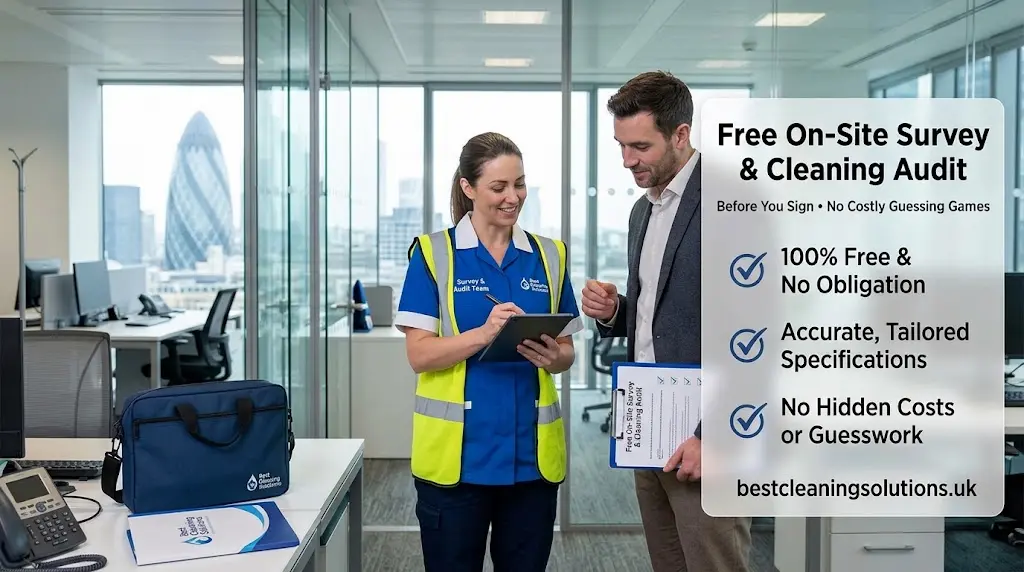
Product Recommendation: We highly recommend starting with our free on-site survey and cleaning audit. This ensures the specification reflects the actual premises before any contract is signed, preventing costly guessing games.
How This Guide Helps You Choose With Confidence
This guide walks you systematically through services, sectors, pricing, compliance, operational areas, testimonials, and FAQs, so you can navigate straight to the definitive proof you need before you call.
The sections that follow break down the specific services you can contract, each with its own frequency model and pricing logic.
Our Commercial Cleaning Services
Every discipline detailed below runs on the exact same basis: a written specification of tasks, specific frequencies, and measurable standards. We never perform a generic clean.
Daily Office Cleaning
What should a daily office clean actually include? The pattern I observe across most London offices is the same: desks wiped, floors vacuumed and mopped, kitchens and washrooms sanitised, and waste removed.
What changes is frequency. A 40-person office with a shared kitchen needs strict daily washroom and kitchen attention; a quiet studio can drop to three visits a week without anyone noticing.
I have walked too many sites where “daily” meant completely different things to the client and the cleaner, and the only possible fix was writing down the tasks, frequencies, and the exact standard expected.
Daily office cleaning covers desks, floors, kitchens, washrooms, and waste, with the frequency strictly matched to footfall and actual premises use.
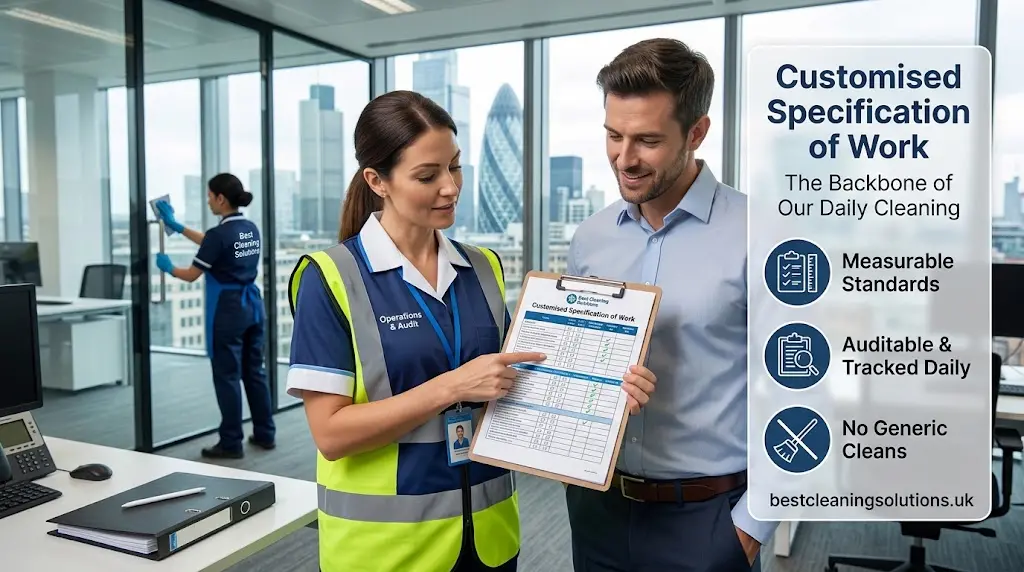
Product Recommendation: Our customised specification of work template turns a generic clean into a measurable, auditable service and is the backbone of our daily cleaning offer.
Expert Tip: Before signing any agreement, always request a professional site survey so the written specification accurately matches your actual premises.
Deep Cleaning and Periodic Cleans
Deep cleaning reaches what routine cleaning cannot: build-up behind desks, high touchpoints, grout lines, extraction filters. It is priced as a one-off or periodic job rather than rolled into the daily rate. Scope varies from site to site, so a written specification matters more here than anywhere.
Carpet and Upholstery Cleaning
Carpet and upholstery work splits into hot water extraction for deep soiling, dry cleaning for quick turnaround, and encapsulation for low-moisture maintenance. As a one-off, a 150 to 175 sq ft office carpet clean costs around £320, which is why most clients bundle it with daily cleaning and schedule it quarterly or after tenant changes.
Window and High-Level Cleaning
Window and high-level cleaning covers internal and external glazing, plus dusting of ledges, beams and light fittings. Access is the real cost driver: upper floors need trained operatives and appropriate equipment, and safety requirements are non-negotiable. Most offices schedule this quarterly or twice a year rather than daily.
Specialist Cleaning: Medical, Food Service and Industrial
Specialist cleaning is three separate disciplines. Medical cleaning works to CQC expectations under the Health and Social Care Act 2008, with colour-coded cloths and mops as one indicator of infection prevention and control. Food service cleaning targets grease build-up, kitchen deep cleans and the conditions that attract pests. Industrial cleaning handles warehouse floors, machinery and high-bay access, where access equipment and COSHH controls matter as much as the clean itself.
Key Holding, Alarm Response and Waste Management
Key holding and alarm response extend the service beyond cleaning hours, with vetted operatives attending alarm activations or opening up for out-of-hours work. Waste and recycling management adds segregation, reporting and compliant disposal, which helps meet sustainability targets and cut landfill costs.
Sectors We Serve
A specification is only as good as its fit to your sector. The one that keeps an open-plan office presentable will fail a hospital ward or a commercial kitchen, because each environment carries its own compliance, scheduling, and quality demands. Here is how the same cleaning disciplines adapt to six different operational realities.
Office and Corporate Cleaning
44.1 percent: that was January’s UK office occupancy figure, and it matched what I saw in my own clients’ access logs, which is why I stopped writing fixed daily schedules. Hybrid working has stabilised above 40 percent, so desks, meeting rooms, and kitchens get used in unpredictable bursts. The specification has to flex around actual usage. Clean the floors and washrooms daily, but treat meeting rooms and breakout areas on a usage trigger rather than a fixed routine. A digital inspection app with photo reporting is non-negotiable here, because consistency across multiple floors is what the client actually audits.
Medical and Healthcare Cleaning (CQC-Compliant)
CQC inspects against the Health and Social Care Act 2008 regulations and the associated Hygiene Code. Colour-coded cleaning is one of the indicators inspectors look for, so separate cloths and equipment for clinical, washroom, and general areas are the baseline. Documented disinfection protocols and operatives trained in infection prevention complete the picture.
NHS trusts spent £1.6 billion on cleaning in 2024-25, up from £1.5 billion the year before. That scale tells you how seriously the sector treats this, and it is why medical rates sit at the top of London’s range.
Education and School Cleaning
Safeguarding comes first. Every operative on a school site should be DBS-checked. Term-time and holiday schedules differ sharply, and the specification needs to build in deep cleans during breaks and flexibility around exam periods. Child-safe COSHH products matter too: you cannot run the same chemical set in a primary school that you would in a warehouse.
Retail Cleaning
High-traffic floor care, entrance matting, window displays, and fitting rooms all need attention while the store is trading. That demands responsive communication and a cleaner who can work around customers without disrupting the floor. The specification should define what gets cleaned during trading hours and what waits for close.
Food Service and Commercial Kitchen Cleaning
Grease trap maintenance, kitchen deep cleans, and pest control awareness sit on top of standard food hygiene compliance. Food service sits alongside medical at the top of London’s compliance overhead, which is why its rates run high. One recurring dispute I see: who pays for consumables and waste disposal.
Industrial and Warehouse Cleaning
Large floor areas, machinery cleaning, high-level dusting, and ride-on scrubbers define this sector. Industrial cleaning runs £33 to £45 per hour in London, reflecting the equipment and safety demands. A generic office specification fails here within the first week.
Sector-specific references and documented inspection routines are the fastest way to verify a cleaner’s claimed expertise. Understanding these sector needs leads directly to cost: the next section breaks down London pricing transparently, including why rates vary and what you should actually budget.
Commercial Cleaning Prices in London: Transparent Cost Guide
Sector requirements directly shape cost. Here are the numbers most competitors hide: current London rates, square-footage models, and monthly budgets. If you’re comparing providers after a bad experience, these figures give you a baseline to test every quote against.
Why London Cleaning Rates Vary (and What That Means for Your Budget)
Location, frequency, size, sector compliance, and inclusions all move the number. A central London office pays more than an outer-borough unit because travel time, congestion, and access logistics cost the provider real money. Frequency changes the rate too: five visits a week spreads fixed costs differently than three. Sector compliance adds another layer. CQC medical cleaning carries documentation and training overhead that a standard office does not.
A provider quoted £0.12 per square foot for a client’s central London floor, and the number looked unbeatable next to the £24 hourly rate from the other bid. I nearly recommended it. Then I read the specification. Consumables were excluded, window cleaning sat as a separate line item, and the frequency dropped to three visits a week instead of five. The square-footage rate was the spec that sounded important; the written scope was the one that actually determined the monthly bill. That gap is why I now compare quotes per task and per square foot, never on the hourly headline alone.
The 2026 London Living Wage sits at £14.80, up 6.9% on the previous year. That rise flows straight into labour costs, which dominate cleaning budgets. A quote that looks cheap against that baseline usually means understaffing, rushed visits, or corners cut somewhere you cannot see.
Typical Hourly Rates by Service Type
| Service Type | Estimated Hourly Rate | Notes |
|---|---|---|
| Standard office cleaning | £19.50–£28 | Outer and mid-London offices, routine daily or weekly cleaning |
| Office cleaning (central London/premium) | £25–£40 | Higher access costs, tighter security, premium finish expectations |
| Industrial cleaning | £33–£45 | Heavier soiling, machinery, safety permits, specialist equipment |
| Specialist CQC medical cleaning | £45+ | Clinical standards, documentation, trained operatives |
| Specialist services (carpet, window, deep clean) | £30–£100+ | Project-based, varies by surface, height access, and soiling level |
Square-Footage Pricing for Central London Offices
For larger premises and long-term contracts, central London providers often quote £0.10 to £0.30 per square foot instead of an hourly rate.
This model suits buildings where the scope is stable and the floor area is the dominant cost driver. It also makes comparisons harder if you do not read the specification, because a low square-footage rate can hide exclusions.
Compare quotes per square foot or per task, not just hourly rates, because providers use different pricing models and hourly rates alone can mislead.
Always request a detailed specification of work, not just a headline price, because a low square-footage rate can hide exclusions for consumables, equipment, or specialist tasks.
Square-Footage Pricing for Central London Offices
For larger premises and long-term contracts, central London providers often quote £0.10 to £0.30 per square foot instead of an hourly rate. This model suits buildings where the scope is stable and the floor area is the dominant cost driver. It also makes comparisons harder if you do not read the specification, because a low square-footage rate can hide exclusions.
Monthly Contract Costs: What to Expect
Small offices in London typically land between £600 and £1,600 per month. Large offices run £4,500 to £12,000 per month. The spread reflects frequency, square footage, sector requirements, and the number of operatives on site. A site survey is essential for an accurate quote. Any provider quoting a firm monthly figure without walking the premises is guessing.
Interactive Quote Calculator: Get an Instant Estimate
The calculator takes two inputs — premises size and cleaning frequency — and returns an instant estimate range based on the rate data above. No phone call, no waiting for a callback.
Your estimated monthly range
—
This is an indicative range only. A free on-site survey gives you a fixed, accurate quote.
Accreditations, Insurance and Compliance
Transparent pricing means little without proof you're dealing with a compliant, insured and vetted provider. This section decodes the acronyms and tells you what to demand.
BICSc, ISO 9001 and CHAS: What They Mean and Why They Matter
BICSc is the British Institute of Cleaning Science, the professional body that sets cleaning standards and trains operatives to a recognised level. ISO 9001 certifies that a provider runs a documented, audited quality management system. CHAS is the Contractors Health and Safety Assessment Scheme, a pre-qualification that confirms health and safety competence before work starts.
Each verifies something different. BICSc covers the skill of the people, ISO 9001 the consistency of the process, CHAS the safety of the operation. Together they are the credibility signals that separate a professional outfit from a man-with-a-mop.
Logos are cheap. During a January tender review for a City office block, I watched a facilities manager shortlist a cleaner on three logos in a website footer. None of the certificates were current. The CHAS registration had lapsed the previous spring, and the BICSc claim traced back to one trained operative, not the team that would turn up.
I review a dozen provider packs a month, and a third carry a lapsed certificate or a logo with no paper behind it. Which is exactly why you ask for current certificates, not branding.
DBS Vetting and Staff Security
DBS stands for Disclosure and Barring Service. A DBS check is a criminal record check on the operative who will enter your premises, often out of hours, with keys and access to sensitive areas. Vetting is a baseline requirement. You need written confirmation that every operative entering your premises is DBS-checked, and the policy should name the check level and how often it is renewed.
COSHH Compliance and Eco-Friendly Products
COSHH is the Control of Substances Hazardous to Health regulations. They govern how cleaning chemicals are stored, diluted, used and disposed of, and they require safety data sheets and risk assessments for every product on site. Compliance is audit-ready proof. A provider that can hand you the product list, the safety data sheets and the COSHH assessments on request is running a controlled operation. Sustainability demand is rising, and eco-friendly products increasingly matter to tenants and tender panels alike.
Public Liability Insurance: What Cover You Should Expect
Public liability insurance covers damage to your property or injury to a third party caused during cleaning. For commercial premises, expect cover in the millions of pounds; the exact level should reflect your site's size and risk. Verify the certificate is current, names your provider correctly, and shows cover that has not lapsed. A certificate dated last year is not proof of cover today.
Areas We Cover in London
A provider can hold every certification going, but none of it matters if they don't cover your postcode. Here's where the service operates.
Central London Boroughs
Westminster (SW1, W1), City of London (EC), Camden (NW1, WC1), Islington (N1), Kensington and Chelsea (SW3, SW10), Hammersmith and Fulham (W6, SW6), Lambeth (SE1, SW8), Southwark (SE1, SE15), Tower Hamlets (E1, E14).
Greater London Coverage
Coverage extends to Brent, Ealing, Hounslow, Richmond, Wandsworth, Merton, Croydon, Bromley, Lewisham, Greenwich, Bexley, Havering, Barking and Dagenham, Redbridge, Newham, Waltham Forest, Haringey, Enfield, Barnet, Harrow, Hillingdon, Kingston upon Thames, and Sutton. Outer boroughs may carry a travel-cost adjustment, so confirm your postcode before enquiring.
"Do you cover us in Zone 3?" a facilities manager asked me last spring, and I've heard the same question from Croydon to Kingston. The pattern is always the same: outer boroughs assume they're outside every cleaner's radius until you confirm the postcode.
Client Testimonials and Case Studies
Coverage is one thing; results are another. Here's what measurable outcomes look like across sectors, from audit scores to CQC inspections. I judge a cleaner by the before and after, not the brochure.
On a Tuesday audit in a central London office, I signed off a paper log without checking the digital trail. The same initials appeared on three floors inside one minute, and I missed it. That mistake cost a full missed clean that only surfaced when the tenant complained. Now I open the digital audit trail before I approve anything, and I look for the impossible pattern first.
Office Sector Case Study: Before and After
One office client came to me after a year of inconsistent quality. Missed visits showed up as tenant complaints, and the previous cleaner's paper log gave no way to check what had actually been done. The fix was a written specification, a digital audit trail, and DBS-checked operatives on every shift. The office manager can confirm the shift in audit scores before and after. For the complaint log, ask to see the numbers. Any cleaner confident in their work will produce both.
Healthcare Sector Case Study: Compliance in Action
A healthcare client needed infection control cleaning that would stand up to a CQC inspection. The previous arrangement left no clean audit record, so the practice manager could not show what had been cleaned, when, or with what. I set a specification tied to COSHH and a daily digital audit trail, with DBS-checked operatives on site. The practice manager can confirm the outcome of the CQC inspection, and the audit record itself is the proof to request. Ask for both before you sign anything.
What Our Clients Say: Testimonials by Sector
Facilities Manager, four-floor office
Daily cleaning with a digital audit trail stopped missed visits, and the complaint log dropped.
Practice Manager, NHS dental practice
Infection control cleaning with COSHH documentation supported a clean CQC inspection.
Site Manager, primary school
Term-time cleaning with DBS-checked operatives and a written specification reduced call-backs after evening events.
Store Manager, high street retailer
Daily floor care and washroom cleaning kept the store audit-ready, and the mystery shopper score improved.
Operations Manager, restaurant group
Kitchen deep cleans with COSHH documentation and waste removal passed environmental health visits without findings.
Facilities Manager, warehouse
High-level cleaning and floor scrubbing with a digital audit trail cut downtime and repeat call-outs.
Get Your Free Site Survey and Quote
You now have the knowledge to choose wisely. The final step is a specification and quote tailored to your actual premises, free of charge.
Free On-Site Survey: What to Expect
A surveyor visits and measures the square footage room by room. We walk the floors together and agree the frequencies: daily for washrooms, twice weekly for offices, monthly for high-level dusting. Floor types, foot traffic, and any sector-specific requirements all get checked on the spot.
The visit takes about an hour for a typical office floor. You then receive a written specification listing every task, frequency, and standard, plus a transparent quote based on the measured square footage.
Free Cleaning Contract Health Check Audit
Already have a cleaner? The audit checks six things: vetting and DBS status, insurance cover, the specification itself, quality inspection records, consumables supply, and waste disposal. Most gaps show up in the specification.
The audit found their old cleaner was paying below the £14.80 London Living Wage, and only then did the client understand why the specification kept slipping — the pay rate was the detail that had been wrong all along.
Contact Us: Phone, Email and Online Form
Ready to book your free site survey? Pick whichever channel suits you — every route reaches the same team, and you'll hear back within one working day.
Phone
07774 121277
Call to book a survey
info@bestcleaningsolutions.uk
Send us your requirements
Online Form
Get My Free Quote
Reply within one working day
After any of these, the next step is the same: a surveyor calls to arrange your free on-site visit.
Frequently Asked Questions
Clear answers on commercial rates, compliance, vetting, and service standards.
How much does commercial cleaning cost in London?
Standard office cleaning runs roughly £20 to £40 per hour in London, depending on the source and scope. Industrial sites cost £33 to £45, CQC medical cleaning starts at £45+, and specialist services reach £30 to £100+.
Square-footage pricing in central London ranges from £0.10 to £0.30 per sq ft. Those spreads exist because every premises differs in size, footfall, and finish. A site survey is the only way to get an accurate quote; anyone quoting blind is guessing.
Do you provide DBS-checked staff?
Yes. Every operative is DBS-vetted as standard. A DBS check covers criminal record history, including spent and unspent convictions, cautions, and warnings where relevant. Written confirmation is available on request before any contract starts.
Can you clean multiple sites to the same standard?
Yes. We use standardised training, robust quality audit tools (app-based), and centralised contract management to maintain consistent, high-standard cleaning across multiple commercial locations throughout London. You are allocated a single account manager for streamlined oversight.
What happens if I'm not happy with the service?
We operate on a written satisfaction guarantee backed by regular digital quality audits. If any task falls below the agreed specification of work, notify your dedicated manager and we will revisit to resolve the flagged area immediately at no extra cost.
Do you supply cleaning products and equipment?
Yes. We provide all required commercial-grade cleaning machinery (HEPA-filtered vacuums, rotary scrubbers) and COSHH-compliant, eco-friendly cleaning chemicals. If your facility requires us to manage washroom consumables (hand towels, soaps, dispensers), this can be itemised directly into the contract.
How do you handle waste disposal and recycling?
We manage internal waste collection and adhere strictly to your facility's recycling and segregation policies (general waste, dry mixed recycling, food waste). We ensure liners are replaced and waste is transferred to your designated central collection bays.
