UK Carpet Cleaning Costs and Methods: A Transparent 2026 Guide

uk-carpet-cleaning-costs-guide-featured-image

The letting agent held back £400 over a hallway carpet that looked clean on the surface but reeked of wet dog underneath.

The tenant had paid for a cheap “steam clean” that never actually extracted the deep grime, leaving excess moisture behind while the intense heat caused the delicate wool fibres to shrink and tighten. That single job broke my habit of defaulting to hot water extraction on every carpet. I lost the quick speed of a one-size-fits-all routine, but gained far fewer callbacks by matching the cleaning method to the fibre type first. Carpet cleaning is never a commodity.

Key Takeaways

  • Transparent Pricing: A professional UK carpet clean typically costs £45–£135 per room, depending on room size, fibre type, and soiling levels. Full house packages generally range from £100 to £500.

  • Method Drying Times: Hot Water Extraction (HWE) remains the gold standard for deep restorative cleaning (drying in 6–12 hours), while low-moisture encapsulation and dry compound cleaning dry in under 1–2 hours.

  • Fibre Protection: Natural wool, berber, and delicate loop pile carpets require specialised low-moisture treatments to prevent shrinkage, browning, and pile distortion.

  • Vetting Standards: Always verify IICRC certification, active public liability insurance, and a written re-clean guarantee before booking any provider.

Eliminating the Guesswork

Two major issues frustrate UK homeowners most:

  1. Opaque Pricing: Lowball teaser quotes where the initial price looks suspiciously cheap, only for the final invoice to double or triple with hidden surcharges.

  2. Method Confusion: Buzzwords like hot water extraction, dry compound, encapsulation, and bonnet cleaning leave homeowners confused. Which method is genuinely safe for your wool loop pile? Which option dries fast enough for tomorrow’s tenancy viewing?

This guide solves both. Below, you will find transparent per-room pricing benchmarks and a plain-English method-matching framework—free from jargon and hidden fees.

Get in touch today for a free, no-obligation quote, or continue reading to see exactly what professional carpet cleaning covers (and what to avoid).

Free, no-obligation quotes. Reply by phone, email or WhatsApp, whichever suits you.

What’s Included in a Professional Carpet Cleaning Service

You’ve seen the promise; here is what a professional clean actually involves, step by step.

A Clear Breakdown of the Standard Service

A proper, professional clean follows a structured 5-step process:

  1. Pre-Inspection & Fibre Testing: The technician identifies your exact carpet fibre (wool, nylon, polypropylene, or blend) and soiling level to choose the right method and chemical balance.

  2. Industrial Pre-Vacuuming: Removing dry particulate soil before introducing moisture prevents mud forming deep within the backing.

  3. Targeted Pre-Treatment: High-traffic lanes and standard surface spots are agitated with safe pre-spray solutions to break down oils.

  4. Deep Extraction / Cleaning: Using the selected professional method (hot water extraction or low moisture) to lift out suspended dirt and residues.

  5. Post-Inspection Walkthrough: You inspect the results with the technician to flag any stubborn areas before they pack away their equipment.

The Truth About Furniture Moving

Furniture moving is where most surprise charges hide. A landlord during a tenancy turnover booked a “full-service” clean, only to find the quote strictly covered exposed open traffic areas. The cleaner did a fine job around the perimeter, but the inventory clerk flagged the dust rings under the sofa and beds. She ended up paying twice: once for the initial clean, and again for a callback visit to finish what was missed.

To keep pricing fair and avoid billing disputes, standard packages usually include moving light, moveable items (chairs, small side tables, floor lamps), but exclude heavy, oversized furniture (wardrobes, solid oak dining sets, large beds, entertainment consoles).

Expert Tip: Always ask whether furniture moving is included or surcharged before booking. Clearing toys, electronics, and small items yourself beforehand saves labour time and keeps your bill at the base rate.

The Carpet and Rug Institute (CRI) strongly recommends confirming whether your technician holds IICRC certification and operates with CRI Seal of Approval tested machinery.

What the Standard Service Does NOT Include

Setting clear expectations upfront prevents awkward conversations on service day:

  • Heavy Architectural Furniture Moving: Large wardrobes, full bookcases, grand pianos, and dismantled bed frames require specialist handling.

  • Specialist Permanent Stain Restoration: Bleach spots, dye transfers, permanent ink, burn marks, or chemical acid stains require dedicated re-dyeing or patch repairs rather than standard washing.

  • Carpet Repairs & Re-Stretching: Fixing delaminated seams, split joins, or rippled backing.

  • Upholstery & Soft Furnishings: Sofas, armchairs, and curtains are treated as distinct services with dedicated fabric requirements.

Having this clear line-by-line boundary allows you to compare competitive quotes on true like-for-like value rather than falling for teaser pricing.

With the scope clear, the next critical step is matching the right cleaning method to your specific carpet type.

carpet-cleaning-5-step-process-diagram

Which Carpet Cleaning Method Is Right for You?

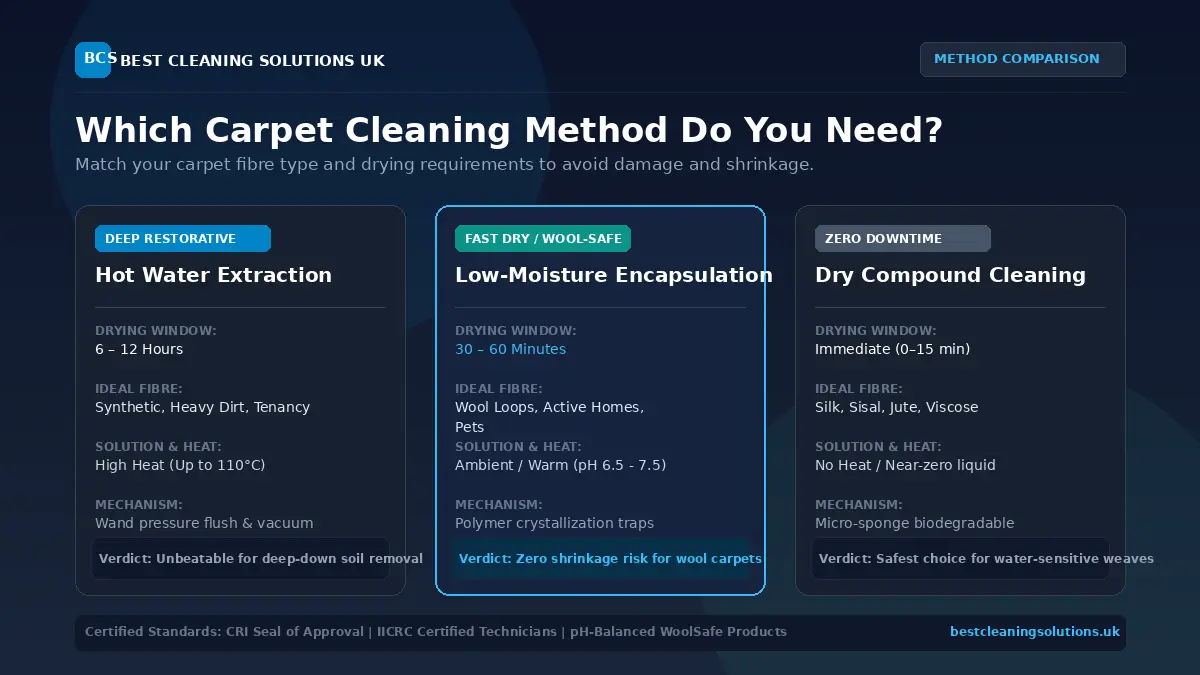
The method you choose directly determines your drying time, the final cost, and whether your carpet fibres emerge soft or permanently damaged. Always match the method to your carpet fibre first, then factor in your drying urgency.
carpet-cleaning-methods-comparison-guide

Find Your Method: 3-Question Quick Selector

Use this simple decision matrix to identify your ideal cleaning treatment:

  • Question 1: What fibre is your carpet?

    • Synthetic (Nylon, Polyester, Polypropylene): Hot Water Extraction (Steam Cleaning).

    • Natural or Delicate (100% Wool, Wool-Mix, Sisal, Viscose): Low-Moisture Encapsulation or Dry Compound.

  • Question 2: What is your primary cleaning goal?

    • Deep sanitisation, pet soiling, heavy ground-in mud: Hot Water Extraction.

    • *Routine surface refresh, high-traffic walkway

Dry Compound Cleaning: Minimal Moisture for Delicate Carpets

A moistened compound is worked into the carpet, absorbs soil, and is vacuumed out. With near-zero drying time, it’s the safest call for wool, silk, and antique rugs.

Bonnet Cleaning: Commercial and Low-Pile Maintenance

A rotating absorbent pad lifts surface soil. This is a maintenance method, not a substitute for deep cleaning, and it suits commercial low-pile carpet between proper cleans.

EXPERT TIP

If a company offers bonnet cleaning for a residential deep clean, ask why. It’s a maintenance method, not a substitute for hot water extraction or encapsulation.

Each method comes with its own price tag, and the gaps between them are worth knowing before you book.

Transparent Pricing: What Carpet Cleaning Costs in the UK

Pricing is where most carpet cleaning websites remain deliberately vague. Here are the realistic benchmarks we operate by across the UK: a full property typically ranges between £250 and £500, individual room quotes average around £90, and single bedrooms generally range between £25 and £35 (or £90–£120 when booked as a standalone single-room visit).

Typical UK Carpet Cleaning Cost Benchmarks

Area / Service Typical Cost Range Coverage & Scope Notes
Bedroom (Single) £25 – £35 Standard small bedroom (approx. 12m²)
Living Room (Standard) £50 – £70 Standard lounge layout (approx. 4m x 4m / 16m²)
Living Room (Large / Through) £80 – £100 Open-plan lounge and dining layouts
Stairs & Landing £35 – £45 Standard single flight & landing (around 15m²; specialist runs £85–£100)
Full House (3-Bedroom) £240 – £280 Average semi-detached property
Full Property (Executive / Large) £250 – £500 Whole home package, depending on total floor area
Standalone Single Room Around £90 Individual room callout (incorporates minimum callout charge)
Specialist Stain Pre-Treatment Priced per stain Requires dedicated chemical spotters (pet accidents, wine, oil)
Furniture Moving Included or small item fee Light furniture included; confirm heavy item terms in advance
End-of-Tenancy Carpet Clean £200 – £450 Full property receipt issued for letting deposit release

Note: Regional variations apply. Central London rates typically sit at the upper end of these brackets (£35–£55 per room for hot water extraction, £105 for a primary lounge), whereas regional areas like Leeds, Berkshire, or the Midlands operate at lower benchmarks. Always confirm local itemised figures rather than assuming London rates apply to your home.

What Actually Drives the Price?

While carpet square footage sets the baseline footprint, soiling severity and stain treatment move the final quote far more than room dimensions alone:

  • Degree of Soiling: A lightly dusted 16m² living room cleans in half the time of an identical room with ground-in grease or pet dander.

  • Targeted Stain Pre-Treatment: Normal traffic lanes respond to standard pre-sprays, but set-in coffee, tannins, or pet accidents require specialised spotters and dwell time.

  • Cleaning Method Selected: Low-moisture encapsulation and dry compound treatments use specialised host compounds, whereas truck-mounted extraction incurs specific equipment setup time.

  • Property Accessibility & Heavy Lifting: High-rise access, parking permit restrictions, and moving oversized furniture items can impact labour requirements.

Why Transparent Itemised Pricing Matters

You have already seen how quickly an ambiguous “starting from £X” teaser quote morphs into an expensive shock on the final invoice. Itemised, room-by-room pricing completely eliminates that friction.

Expert Tip: Always insist on a written quote that clearly itemises every single room, hallway, flight of stairs, and stain treatment before booking. This gives you complete transparency to compare providers like-for-like and prevents unexpected line items on the day.

While transparent pricing provides peace of mind on cost, technician credentials and work guarantees represent the other half of the trust equation.

Credentials, Insurance, and Guarantee: What to Check Before You Book

A fair price means nothing if an untrained operator ruins your carpet or vanishes the moment problems arise. Three non-negotiable checks separate genuine, qualified professionals from reckless chancers: formal certification, comprehensive insurance, and a written re-clean guarantee.

Certification: Why IICRC and the CRI Seal of Approval Matter

Industry certifications confirm scientific training rather than just the ability to push a machine:

  • IICRC Carpet Cleaning Technician (CCT): The Institute of Inspection, Cleaning and Restoration Certification (IICRC) sets global standards. The CCT curriculum covers precise fibre identification, chemical pH scales, and heat tolerance. Sitting through the IICRC course after a decade in the field exposed how much standard cleaners guess when handling delicate wool. Getting pH or water temperature wrong by even a small margin causes irreversible fibre distortion, colour bleeding, and shrinkage.

  • CRI Seal of Approval: Issued by the Carpet and Rug Institute (CRI), this standard independently tests both equipment and chemical formulations to verify they extract soil effectively without stripping carpet fibres or voiding manufacturer warranties.

Expert Tip: Before booking, always confirm whether your technician holds active IICRC CCT credentials and utilizes CRI Seal of Approval tested machinery. Verified qualification logos and technician registration details should always be readily provided upon request.

Insurance: Two Critical Policies Every Cleaner Must Carry

Never assume general business insurance covers your flooring. Always ask to see the certificate for two specific protections:

  1. Public Liability Insurance: Protects your wider home, fixtures, walls, and skirting boards if an equipment hose leaks, a fitting bursts, or water causes structural damage.

  2. Treatment Risk Cover (Goods Worked Upon): Standard public liability often explicitly excludes the exact item being cleaned. Treatment risk insurance ensures that if a chemical reaction, dye bleed, or pile shrinkage ruins the carpet itself during treatment, full replacement cost is guaranteed.

Expert Tip: Ask to see the active insurance certificate before paying any deposit. Hesitation or refusal to share verifiable documentation is an immediate red flag.

Written Guarantee & Free Re-Clean Policy

A verbal promise of satisfaction is practically useless when disputes arise. A genuine professional guarantee must be provided in writing and outline:

  • The Notification Window: A clear timeframe (typically 24 to 48 hours post-clean) to report any spots, rapid resoiling, or missed traffic lanes.

  • The Resolution Trigger: If an agreed area fails to lift or shows post-drying residue, the provider returns to re-clean the flagged space free of charge.

  • Refund Safeguard: Clear recourse if the re-clean cannot rectify an operational issue.

If a contractor hesitates to state their guarantee terms in writing before service day, walk away.

Securing verified credentials, comprehensive treatment insurance, and a written re-clean policy protects your investment before work begins. Next, let’s look at post-clean drying times and simple steps to prepare your home.

Drying Times and How to Prepare for Your Carpet Clean

You have matched the right method and verified your technician’s credentials. Now, it is time to plan around the drying clock—because the gap between a completed clean and fully dry fibres decides whether you sleep in your bedroom tonight or stay off the carpets until tomorrow.

Expected Drying Times by Method

Cleaning Method Typical Drying Time Best Suited For
Hot Water Extraction (Steam Clean) 6 – 12 Hours (up to 24 hrs in cold/humid weather) Deep restorative cleans, synthetic fibres, end-of-tenancy
Low-Moisture Encapsulation 30 – 60 Minutes Routine maintenance, wool carpets, active busy households
Dry Compound Cleaning Immediate – 30 Minutes Delicate natural fibres (silk, sisal), zero downtime needs
Bonnet Cleaning 1 – 2 Hours Commercial carpet tiles, interim visual maintenance
💡 Expert Tip: Always ask for the anticipated drying window upfront. If you need rooms back in service the same afternoon for children, pets, or incoming guests, communicate that before confirming your booking.

Factors That Dictate the Drying Clock

Airflow, ambient relative humidity, and pile density all affect the evaporation rate. A heavy-weight wool twist in an unventilated room takes considerably longer than a low-profile synthetic loop in a warm, draughty hallway.

The single biggest differentiator is the drying equipment deployed on-site:

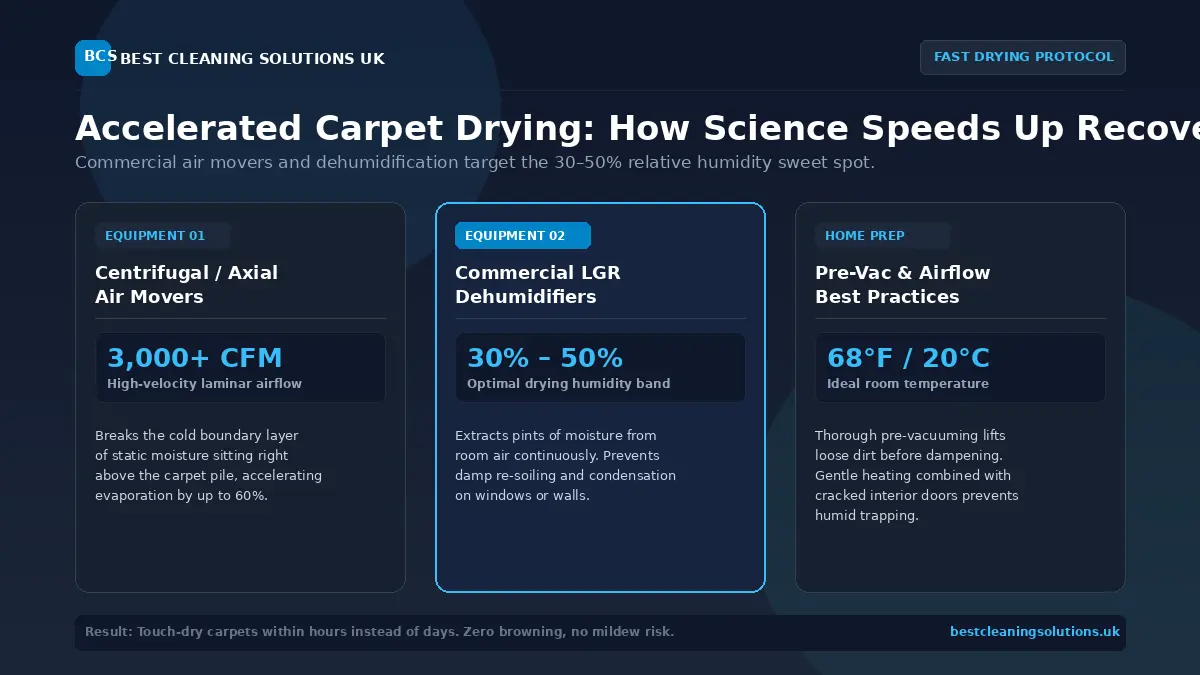
  • Target Relative Humidity (30–50%): On a rainy November job in a terraced house, a technician set a commercial dehumidifier at 60% relative humidity, leaving the pile damp even after hours. Adjusting the target into the optimal 30–50% humidity band and angling an axial air mover across the floor created rapid evaporation—bringing the pile to touch-dry within a couple of hours.
carpet-drying-equipment-process-guide

  • Air Mover Circulation: Directing high-velocity air movers across the carpet surface breaks the boundary layer of moist air sitting on the pile, dramatically accelerating natural dry times.

Always ask your service provider whether industrial air movers or low-grain refrigerant dehumidifiers are deployed as part of their standard deep-clean procedure.

How to Prepare Before Your Technician Arrives

A few simple preparatory steps protect your furnishings and maximise your cleaning investment:

  1. Pre-Vacuum Thoroughly: Running your home vacuum beforehand removes loose dry soil, hair, and surface debris, allowing the technician’s industrial equipment and pre-spray to target deep, bonded grit rather than surface fluff.

  2. Clear the Floor Area: Move light items off the carpet—including shoes, floor lamps, wastebaskets, small side tables, and children’s toys—so technicians can work unhindered.

  3. Pinpoint Problem Spots: Note the location and origin of specific spills (coffee, pet accidents, red wine, cosmetics) during the pre-inspection walk so the right chemical neutralisers can be applied.

  4. Secure Pets & Children: Arrange a comfortable, carpet-free space for pets and little ones away from hoses, warm water lines, and open entryways.

  5. Facilitate Airflow: Keep interior doors open and leave heating at a comfortable 18°C–20°C (or crack windows slightly in temperate weather) to encourage air exchange.

Visible results are ultimately what you are investing in. Here is how to verify real customer transformations and past work before you commit.

Frequently Asked Questions

These are the most critical questions homeowners and tenants ask before booking, answered straight:

What is the best cleaning method for wool carpets?

Natural wool demands low-moisture encapsulation or dry compound cleaning using strictly wool-safe, pH-neutral solutions (pH 5.5–8.0). Excessive water or high alkaline detergents cause permanent fibre shrinkage, pile distortion, and cellulosic browning. Always ask your prospective cleaner directly about their specific experience with natural wool and which low-moisture system they deploy.

How long does carpet cleaning take to dry?

Drying time depends entirely on the method chosen:

  • Low-Moisture Encapsulation & Dry Compound: Dries in 30 to 60 minutes.
  • Hot Water Extraction (Steam Clean): Typically requires 6 to 12 hours, extending up to 24 hours in thick pile or cold/humid weather.
Can you remove pet stains and odours?

Surface cleaning alone cannot eliminate deep pet accidents. Pet urine contains uric acid crystals that penetrate through the carpet backing directly into the underlay. Effective treatment requires an enzymatic or oxidising pre-treatment to neutralise crystal salts before deep extraction. Any provider claiming a standard rinse will cure sub-surface pet odours on contact has not dealt with underlay contamination.

Do I need to move furniture before the cleaner arrives?

Clearing small, portable items (toys, floor lamps, side tables, small chairs) yourself saves significant labour time and keeps your bill at the baseline rate. Standard packages include moving light pieces, while oversized architectural furniture (solid wardrobes, full bookcases, large beds) remains stationary.

How often should carpets be professionally cleaned?

Having carpets professionally serviced every 12 to 18 months extends fibre life, restores pile bounce, and extracts abrasive soil. Busy households with shedding pets, active children, or allergy sufferers should clean every 6 to 9 months. Additionally, most major UK carpet manufacturers require professional cleaning at regular 12-to-18-month intervals to keep their wear warranties valid.

Are the cleaning products safe for children and pets?

Yes. Professional technicians prioritise bio-based, hypoallergenic, and non-toxic formulations that leave zero chemical residue on walking surfaces. You should always ask your cleaner to confirm the exact low-residue, CRI-approved, or allergy-safe certifications they hold before work commences.

What is the difference between a professional clean and hiring a supermarket machine?

Supermarket rental machines feature low-power vacuum motors, inconsistent water heating, and generic detergents. They frequently over-wet carpets and leave sticky detergent film that attracts dirt faster. Professional van-mounted and industrial portable systems deliver high-temperature sanitisation with powerful multi-stage vacuum recovery, flushing soils out rather than driving them deeper.

Do you clean end-of-tenancy carpets for deposit release?

Yes. End-of-tenancy carpet cleaning is designed to satisfy letting agent and landlord inventory checklists. Packages start from £36 per room and include formal itemised receipts alongside a 48-hour re-clean guarantee to safeguard your security deposit.

Book Your Carpet Clean: Instant Quote & Next Steps

You have done the research; now secure an accurate, itemised price in under 60 seconds.

⏱️

Instant Per-Room Quote

Enter your postcode, select your rooms, and choose your cleaning method. Your multi-line estimate calculates on screen in seconds—no 20–45 minute waiting for callbacks and zero hidden fees.

🛡️

What to Expect on the Day

A named, vetted technician arrives on schedule, completes a pre-clean fibre & soiling assessment, executes the tailored treatment, and walks through the results with you before departing.

📍

Visibly Local Accountability

Direct knowledge of UK housing stock—from Victorian high ceilings to city apartments. Real verified reviews, transparent local accountability, and zero unvetted third-party sub-contracting.

Sources & Industry Standards

Every pricing benchmark, standard, and technical recommendation in this guide is grounded in established industry research:

Certification & Method Guidance:
  • CRI (Carpet and Rug Institute): Seal of Approval testing & consumer vetting standards.
  • IICRC: Carpet Cleaning Technician (CCT) procedural science & fibre identification.
  • HGTV Home Improvement: Comparative analysis of dry vs. steam extraction methods.
Cost & Labour Benchmarks:
  • MyJobQuote UK: 2026 regional room-by-room pricing data.
  • MyBuilder: Verified UK domestic carpet cleaning cost breakdowns.

Free, no-obligation quotes. Reply by phone, email or WhatsApp, whichever suits you.

Scroll to Top